
An articleHéritage Montréal Maude Bouchard Dupont, in collaboration with Dinu Bumbaru, Director of Policy, and Marie-Maxime de Andrade, PhD candidate in art history (UQAM and Paris 1 Panthéon-Sorbonne).
Art Deco between tradition and modernity
The term "Art Deco" takes its name from the Exposition internationale des arts décoratifs et industriels modernes, held in Paris in 1925. It was at this time that this aesthetic, born as early as the 1910s, emerged as a movement in its own right. Preceding the International language, it was initially referred to as Art Moderne or Nouveau Style.1. The term "Art Deco" really took hold in academic circles in the 1960s, and began to be used thereafter.
A transitional architectural style between traditionalism and modernity, Art Deco is characterized by verticality, synonymous with progress and optimism. To achieve this, buildings are embellished with pilasters alternating with vertical windows. Pilasters and entrances are crowned with stylized ornamentation suggesting upward elevation. The higher the building, the thinner its height (recess, setback, landing, tier, etc.).
Abandoning all reminders of historicism, Art Deco focuses on straight lines. Envelope materials (such as marble and granite) are smooth and pale in color. Evocative of modernity, metal, such as steel or bronze, is regularly used for ornamentation.
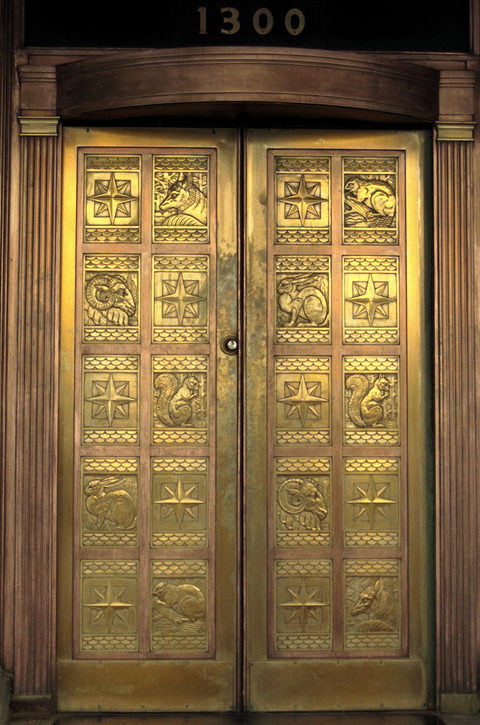
More pared-down, the ornamentation is concentrated in certain easily visible places (crown, near windows and doors, in the center of the facade). This often reveals the building's function, industrialization or stylized, simplified or schematized geometric or figurative motifs.
Some of these modern motifs draw their inspiration from the art of Africa, Asia, the Middle East and Mesoamerica, as well as from ancient or pre-Columbian archaeological discoveries (Egyptian, Mayan, Aztec, Sumerian, etc.).
Highlights include: Théâtre des Champs-Élysées in Paris, France (1913); Empress (1927), Outremont (1928) and Le Château (1931) theaters;Aldred Building and Maison Ernest-Cormier (1931); Montreal-Pharmacie (1934); Holt Renfrew Building (1937) in Montreal, Canada;Empire State Building and Chrysler Building in New York (USA) (1931); Mayan Theater in Los Angeles (USA) (1927); Holt Renfrew Building in New York (USA) (1937).U.) (1927)
And the modern Streamline (or Paquebot)?
A current of Art Deco that emerged in force in the late 1930s, Streamline Moderne refers in the USA to the "stream of the stream" or "modern rationalization", while in France its equivalent is expressed as the "Paquebot" style.
Inspired by motorized vehicles and speed, he seeks to accentuate horizontal lines with aerodynamics. Straight lines end in rounded, curved or semi-circular corners, reminiscent of the shape of a boat. Metals are visible in the sober ornamentation.

Some highlights: La Casa d'Italia, the Beaubien and Snowdon theaters in Montreal (Canada) (1936), the liners Île-de-France (1927) and SS Normandie (1932) (France), the San Francisco Maritime Museum (USA) (1939)
Art Deco in every sauce
Evoking the luxury of the 1920s, Art Deco was quickly adopted by Parisian department stores such as La Samaritaine and Le Printemps to market a modern lifestyle. Architects, artists, decorators and designers adopted it and adapted it to a multitude of contexts.
Visible in architecture and the decorative and visual arts, this totalizing yet eclectic movement shapes everyday objects, fabrics and furniture, as well as buildings, transport and gardens. It even inspires the design of boats, trains, automobiles and even household appliances.
From Europe to Morocco, via the Americas and even as far afield as India, Art Deco easily adapts to local colors, which it reflects in an aesthetic emblematic of that place.
This language flourished in the 1920s and 1930s. More exuberant during the Roaring Twenties, it mellowed in the decade of the Depression.
And in Montreal?
"[....] Montreal architects developed a distinctive Art Deco, with a unique style and vocabulary. Tempered by the cautious nature of Canadians and long Canadian winters, this Nordic Art Deco style reflects Montreal's cultural, political, economic and technological realities.2"
Sandra Cohen Rose
As elsewhere in the world, Art Deco in Montreal doesn't exactly respect all the theoretical criteria of the architectural style, but they are apparent enough to observe the kinship.
Art Deco was particularly popular in the Quebec metropolis during the 1930s. Its sparse ornamentation and simple lines saved on construction costs. It thus became the language of choice for civic buildings erected during the period of unemployment, as well as for school buildings in the metropolitan area. These public buildings embodied the modernity, progress and optimism that would triumph in these years of economic hardship.
In Montreal, the use of materials such as granite or marble is rarer. Instead, light-colored bricks (chamois brick, for example) or limestone are used. That said, architects don't shy away from equipping their sleek buildings with state-of-the-art materials such as reinforced concrete, steel and glass.

On the other hand, typically Canadian symbols such as the beaver,squirrel, maple leaf, spruce, pine, birch and many others are skilfully combined with more traditional Art Deco elements like the urn, rising sun and waterfall.
Highlights of 1930s civic buildings: VerdunAuditorium and Natatorium, Botanical Garden reception pavilion, Atwater, Saint-Jacques, Saint-Jean-Baptiste (demolished) and Jean-Talon markets, Hogan, Quintal and Schubert baths, fire stations no. 23 Saint-Henri, no. 31 Saint-Dominique, no. 48 Hochelaga.
Cover photo: Aldred Building, Place d'Armes, Montreal, Night, [between 1930-1950]. Credit: BAnQ
- Other terms are also used, such as Modernism, Jazz Style ZigZag and Style 1925. Sources : Sandra Cohen-Rose, Northern Deco : Art Deco Architecture in Montreal, Montreal: Corona Publishers, 1996.p.12 ︎
- Translation by the author. Source : Sandra Cohen-Rose, Northern Deco : Art Deco Architecture in Montreal, Montreal: Corona Publishers, 1996. p.11 ︎



1 comment
Bravo and above all out grand merci for this article. Thank you